If you’ve spent any time around AI agents lately, you’ve heard someone say “it’s not the model, it’s the harness.” Release notes mention harness improvements. Benchmarks report scores “with our harness.” Engineers argue about whose harness is better.
It’s one of those words everyone uses and almost nobody stops to define. So let’s define it.
The short answer
A harness is all the software wrapped around an AI model that turns it into something useful. The model is the part that predicts text. The harness is everything else: the code that feeds it instructions, hands it tools, runs those tools, remembers what happened, and decides when the job is done.
The word comes from horses. A horse is powerful, but on its own it just wanders the field. Put it in a harness and connect it to a cart, and that power goes somewhere useful. The harness doesn’t make the horse stronger; it directs the strength the horse already has.
An LLM is the same. On its own, a model takes text in and sends text out. It can’t read your files, run a command, browse a website, or remember yesterday’s conversation. It can only say “I’d like to run this command.” The harness is what actually runs it, captures the output, and passes the result back so the model can decide what to do next.
A useful shorthand: agent = model + harness.
What’s inside an agent harness
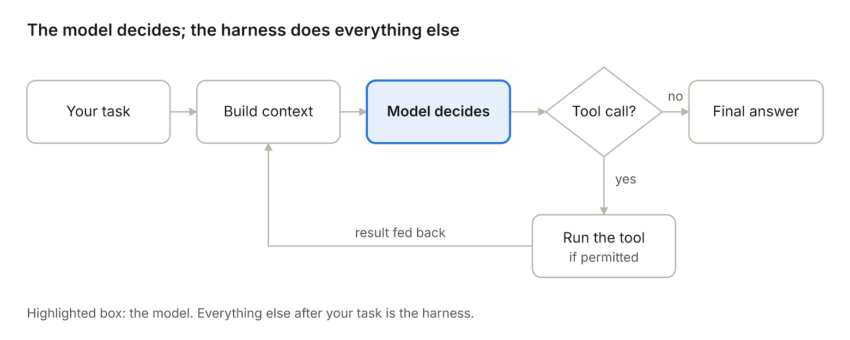
At its heart, every agent harness runs the same loop: send the model a request, check whether it asked to use a tool, run that tool, feed the result back, and repeat until the model says it’s finished.
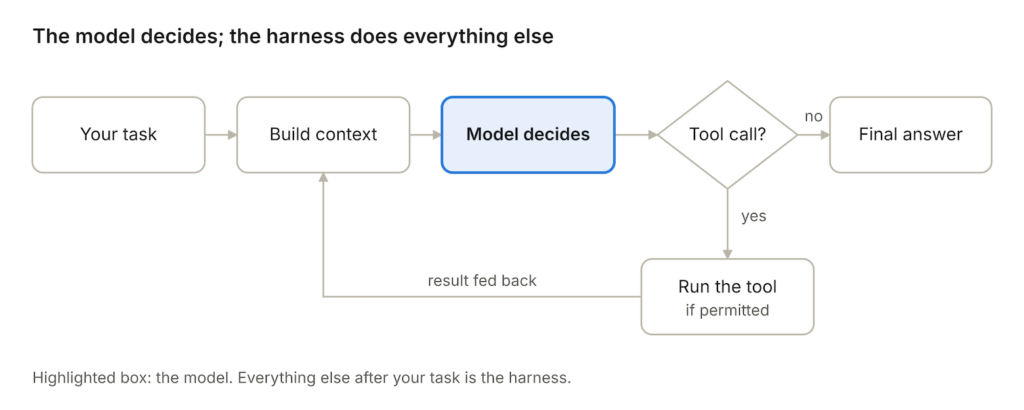
The model only ever makes one decision per turn: answer, or ask for a tool. The harness does the rest and keeps the loop going.
Around that loop, a typical harness handles:
- The system prompt. The standing instructions the model sees before your request: who it is, how to behave, what format to answer in, which rules to follow.
- Tools. The list of actions the model is allowed to request (read a file, search the web, query a database, call an API), plus the code that actually performs each one.
- The agent loop. The orchestration described above, including retries when a tool fails and a stopping condition so the agent doesn’t run forever.
- Context management. Models can only see so much text at once. The harness decides what goes into that window, and summarizes or trims older material when a long task fills it up.
- Memory. Notes, files, or databases that persist between sessions, so the agent can pick up where it left off.
- Permissions and guardrails. Rules about what the agent may do without asking: reading a file is fine, deleting one needs your approval, spending money is off limits.
- The environment. Where the tools run: a sandboxed container, your laptop, a cloud VM, a browser.
- Observability. Logs and traces of every step, so humans can see what the agent did and why.
The other meaning: evaluation harnesses
There’s a second, older use of the word, and it trips people up. An evaluation harness (or test harness) is the software that runs a model through a benchmark and scores it.
The term comes from traditional software testing, where a “test harness” is the scaffolding that feeds inputs to code and checks the outputs. In AI, the best-known example is EleutherAI’s open-source Language Model Evaluation Harness, which powers Hugging Face’s Open LLM Leaderboard and has been used in hundreds of research papers.
The two meanings overlap more than you’d think. Agent benchmarks, like those that ask a model to fix real GitHub issues, need an evaluation harness and an agent harness: one to hand the model a task and grade the result, the other to let it actually read code and run tests. When a lab says a model scored X “with our harness,” they usually mean the agent scaffolding it used during the test.
Rule of thumb: if the conversation is about scoring a model, it’s an evaluation harness. If it’s about running an agent, it’s an agent harness.
Why the harness matters as much as the model
The same model can feel brilliant in one product and clumsy in another. Usually the difference is the harness, not the model. That’s why Parallel’s explainer describes the harness as the reason identical models perform differently across products.
A few reasons it carries so much weight:
- Models can’t act on their own. A raw model only predicts text. It holds no state between calls and can’t touch the outside world. Every real action passes through the harness.
- Reliability lives in the plumbing. Retrying a failed API call, catching malformed output, stopping an agent stuck in a loop: these are harness jobs. As Olostep puts it, most agent reliability is won in the harness rather than the model.
- Context is the scarce resource. On a long task, what the model sees at each step decides how well it performs. Good harnesses curate that context carefully; poor ones drown the model in noise.
- Safety is enforced here. The model may suggest deleting a database. The harness is what says no. Deterministic rules in the harness backstop a probabilistic model.
- Harnesses are portable. Swap in a newer model and a well-built harness keeps working. Teams increasingly treat the harness as the durable investment and the model as a replaceable part.
Harnesses you’ve probably already used
If you’ve used an AI coding tool or a chat assistant that can search the web, you’ve used a harness.
Example | What kind of harness | What the harness adds to the model |
|---|---|---|
Claude Code, OpenAI Codex CLI | Coding agent | File reading and editing, running terminal commands and tests, approval prompts before risky actions |
Cursor, GitHub Copilot agent mode | IDE agent | Access to your open project, code search, applying edits across files |
ChatGPT, Claude apps | Chat assistant | Web search, file uploads, memory across conversations, a system prompt |
Claude Agent SDK, LangGraph, OpenAI Agents SDK | Toolkits for building your own | Ready-made loops, tool wiring, and state handling you assemble into a custom harness |
EleutherAI LM Evaluation Harness | Evaluation harness | Benchmark tasks, prompt formatting, and scoring |
Note the distinction in that fourth row. A framework or SDK is a kit for building a harness; the harness is the specific thing you assemble from it for one agent.
The takeaway
Next time someone says “harness,” ask yourself which one they mean:
- Agent harness: everything around the model that lets it take actions, use tools, remember, and stay within safe limits. Model + harness = agent.
- Evaluation harness: the test rig that runs a model through benchmarks and scores it.
And when you’re comparing AI tools, don’t just ask which model is under the hood. Ask how good the harness is. More often than not, that’s where the real difference lies.