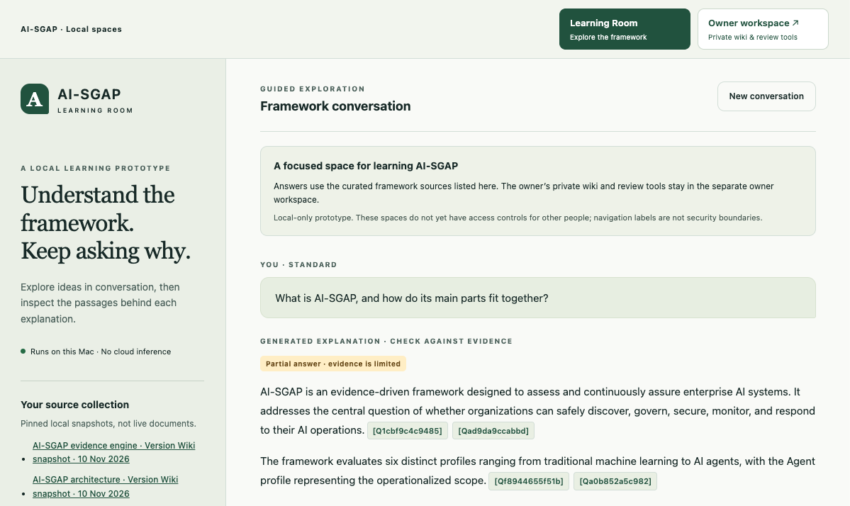
On November 12, I tried to open the Learning Room, the interface I actually used to ask my local knowledge wiki a question. It was down. We had already tested the owner workspace behind it. That gave us confidence in a path I wasn’t using.
The distinction mattered on a Mac that was also running a local model. It was tempting to blame memory pressure. When we checked the recovered system, memory pressure was normal and swap usage was zero. That observation tells us about the machine at recovery time. The operational gap we could identify was simpler. The interface depended on a temporary process. A successful backend test said nothing about whether that process would be there when I came back.
Change the recovery test
By 19:11 UTC the Learning Room was reachable again. The first round of work added supervised startup and recovery. We also improved the owner wiki’s retrieval for patent-related questions. At that checkpoint, 80 Learning Room tests and 205 owner-workspace tests passed. One complex follow-up was still withheld. Those outcomes belong on different lines in the run record. An interface can recover correctly and still have too little evidence to answer a question.
Here’s how I’d reproduce the recovery check on another machine. Use the same saved URL, account and question a daily user would use. Keep a backend probe alongside the browser test so you can locate a failure.
Exercise | What to capture |
|---|---|
Open the saved URL from a fresh browser session. | Does the intended interface load, and can the user submit a question? |
Ask a question with a known supporting passage. | Do the answer and its citation both render? Can you open that passage? |
In a disposable setup, stop the UI process while the backend is healthy. | Which probe detects the interruption? Does the supervisor start a replacement? |
Reopen the same URL and repeat the question. | Record elapsed recovery time and the user-visible result. |
Ask a follow-up that requires evidence from two passages. | Record whether both claims are supported or the system withholds the unsupported portion. |
For a local deployment, write down what starts the service, what happens when its child exits, where startup errors go, and which URL the owner has bookmarked. Then close the terminal used for setup and run the browser check again. That last step is easy to skip when the engineer who started the service is also the person demonstrating it.
The outage changed my priorities for the wiki. I needed to open it and get a quick, traceable answer about my own work. That became the first workflow. The patent assistant would build on that foundation. Training other people could come later. The acceptance test now had a recognizable starting point: me opening the Learning Room the next morning.