The hardest sale is the one about your own ending
Selling AI security assurance is selling life insurance. You ask a buyer to pay today for protection against a day they would rather not picture. And the deal stalls for the same reasons.
Every insurance agent knows the pattern. The product makes sense, the prospect nods, and then the subject changes. Nobody enjoys rehearsing their own funeral.
I think about that problem as the founder of AI-SGAP, short for AI Security Gap Analysis & Prioritization. “Our AI pilot is small” is a perfectly sensible response to a pitch about a company-wide disaster. A lending executive with a pilot to approve on Friday has a more immediate question. What can I safely let this agent do on Monday?
That question is where the life-insurance analogy gets interesting. In cyber, the same people who sign the check today may have to bring the business back tomorrow.
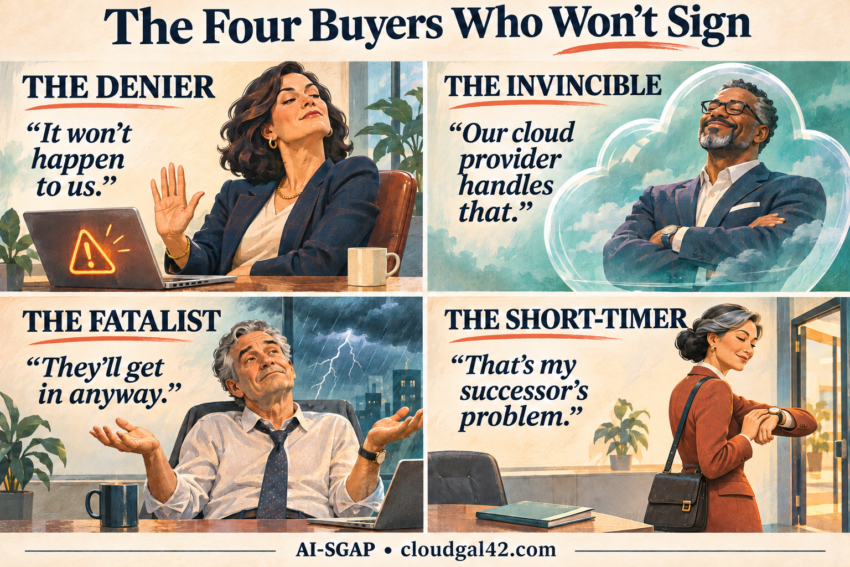
The four buyers who won’t sign
| Buyer | What they say | The life insurance twin |
|---|---|---|
| The Denier | “It won’t happen to us.” | The 35-year-old who “has time.” |
| The Invincible | “Our cloud provider and model vendor handle that.” | The employee who assumes the policy at work covers everything. |
| The Fatalist | “If attackers want in, they’ll get in.” | “When it’s my time, it’s my time.” |
| The Short-Timer | “That’s a problem for whoever comes after me.” | The buyer who sees little personal benefit in the payout. |
The Short-Timer is the most honest of the four. A CEO on a three-year horizon has good reason to pay attention to the costs that will land during those three years. Telling them to protect their legacy asks them to buy a policy for someone else’s benefit.
Fear gets you about as far with the other three. The Denier and the Invincible deflect it. The Fatalist absorbs it. You need a frame where the payoff belongs to the person signing.
What if you got to come back?
Imagine a life insurance policy that paid you when you came back. You would stop asking how you feel about dying. You would start asking what you want your next life to look like.
For an organization, I can picture three versions of that comeback. In one, customers get a clear account of what happened and operations resume with the right safeguards. In another, people spend weeks on manual work while leadership tries to agree on what can reopen. In the third, the company comes back with amnesia. Someone approved the agent. Someone tested it. Nobody in the room can say which version they tested, what it could access, or what the approver knew.
That third outcome is the one I had in mind building AI-SGAP. An audit trail of the agent’s actions helps investigators reconstruct an incident. An assessment record answers a different question that matters just as much afterward. What evidence did we rely on when we gave this agent permission to work?
How the investment math changes
IBM’s 2026 study put the average cost of a breach at $4.99 million. Among the malicious breaches studied, one in four involved an attacker using AI, and those breaches averaged $6 million. A CFO can take those numbers seriously and still ask what an assessment is worth to this business. IBM’s 2026 Cost of a Data Breach findings
I’d start with the lending operation’s own numbers. Suppose it sends 400 files a day back to manual review while an agent is paused. If each file takes an extra 15 minutes, that’s 100 additional staff hours per day. Then I’d ask the head of lending how many of those hours the team can absorb before borrowers start missing closing dates.
Those are hypothetical inputs. The buyer can replace them with actual volumes and handling times. Now the CFO and CISO have a shared reason to care about a precise restart decision. If one use of the agent can resume safely while another stays on hold, what would that mean for the people working through tomorrow’s files?
Where AI-SGAP fits in a mortgage pilot
Imagine a bank piloting an agent that summarizes documents for a loan officer. Its approved scope is narrow. It reads documents for the assigned application and drafts a summary for human review. Credit decisions stay with the bank.
The team submits its access policy. It says the agent can read only the assigned borrower’s file. That tells the assessor what the bank intended. A test in which the agent tries to open a second borrower’s file tells the assessor something the policy alone cannot. Did the system actually refuse?
This is the distinction I want AI-SGAP to preserve. The customer supplies evidence. The assessor can ask a focused follow-up. The customer can also say, “That’s all we have.” In a rehearsal of the evidence workflow, we reached exactly that point. The review could close with the limitation recorded. The control’s effectiveness stayed unknown. Finishing the paperwork and proving the safeguard works are two different accomplishments.
Here’s what that means across the life of this hypothetical pilot.
| Moment | What the bank needs | What AI-SGAP contributes |
|---|---|---|
| Before launch | Decide whether the agent can work with live borrower files. | A scoped assessment showing which safeguards the evidence supports, which questions remain open and which gaps stand in the way of release. |
| When a concern surfaces | A loan officer flags a summary containing unfamiliar details. Investigators need to know what the bank previously verified. | The assessment record gives responders the approved scope, evidence reviewed and known limitations. The bank’s application and security logs supply the account of what the agent actually did. |
| Before restart | Decide whether the corrected agent can resume a particular task. | The team can bring the fix and its retest back for review. Decision-makers can see what the new evidence establishes and which uses still need approval. |
Suppose the bank has excellent evidence that every summary gets a human review. That helps with summary quality. It does very little for the borrower whose file the agent should never have opened. AI-SGAP’s risk floors reflect that distinction. A serious unresolved gap can hold up a release even when the team has done good work elsewhere.
That gives the executive signing today something they can use today. They can explain why the pilot may continue with synthetic files, what evidence they need before authorizing live files, and who owns that decision. The same record will be there if a different executive has to explain it six months from now.
A sales playbook for the recovery pitch
I’d give each buyer a question they can answer about an agent they already own.
| Buyer | Opening question |
|---|---|
| The Denier | “Pick one thing your pilot agent must never do. When did someone last try it, and can we see the result?” |
| The Invincible | “Your provider documented how its platform isolates customers. Who tested whether your agent can cross between two borrower files inside your own account?” |
| The Fatalist | “Assume you pause the agent tomorrow. Which part of the workflow could you reopen first, and what would you need to see?” |
| The Short-Timer | “If the board asks about the pilot you approved this quarter, can you show them what you knew when you signed?” |
Three habits make the conversation stick. Price the manual fallback in the buyer’s own terms. Tie the work to a decision the buyer owns this year. And ask to see one piece of evidence together. A failed access test, or even the discovery that nobody has run it, will teach both of you more about the sale than another slide about breach costs.
Buy the policy for the life after
Life insurance asks you to care about a world without you in it. AI assurance offers something more immediate. You’ll be there on Monday when the head of lending wants to turn the agent on. You may also be there on Thursday when a loan officer spots something odd and someone has to decide what happens next.
I’m building AI-SGAP for the person who has to sign their name on both days. Give them a record they can trust, including an honest account of what they still don’t know. That’s a policy worth buying while everyone is alive and well.
Follow the build here.